San Francisco Tariffs

The San Francisco Tariff Taxes
If you’ve been following the national news lately, you’ve probably heard a lot about tariffs. A tariff is essentially a tax a government places on goods and services coming from somewhere else. Economists widely agree that tariffs often backfire, raising prices and ultimately hurting consumers.
But here’s something many people don’t realize: San Francisco has its own version of tariffs.
Our city has created a long list of taxes that are unique to San Francisco and don’t exist in most other places. These policies add extra costs to doing business and living here. Some were created with good intentions, others for political reasons, but the end result is the same.
The costs don’t disappear. They get passed along to residents through higher prices, fewer jobs, and fewer local businesses. Any one tax might not seem like much on its own. But together, they add up fast. Even after recent reforms, businesses in SF still face some of the highest local taxes in the region. Unsurprisingly, San Francisco remains one of the country’s most expensive cities.
Below are a few examples of the “San Francisco tariffs” our city effectively imposes on itself.
.png)
“CEO” Tax
What it is: The “CEO Tax,” formally known as the Overpaid Executive Tax, is actually a business tax that applies to companies based on the pay ratio between their CEO and their median San Francisco employee.
How it works: The tax begins to apply when a company’s CEO earns 100 times or more than the median SF-based employee. The tax has two main components.
- Most businesses that generate revenue in SF are subject to the Overpaid Executive Gross Receipts Tax, which applies to companies with taxable gross receipts in the city. This tax’s rates range from 0.02% to 0.12%.
- However, companies that primarily operate as administrative offices i.e. headquarters in SF, meaning more than 50% of their payroll expenses in the city are tied to administrative or management services, are instead subject to the Overpaid Executive Administrative Office Tax. This tax’s rates range from 0.08% to 0.48%.
Certain organizations, including nonprofits, are exempt from the tax.
How it’s a tariff: Economic research shows that business taxes are often passed on to customers through higher prices. Because San Francisco’s CEO tax is rare, it adds a cost that residents here bear but people in most other cities don’t. Since the tax impacts grocers, pharmacies, retailers and other businesses, that translates to more expensive groceries, medicine, and other goods for residents.
Notably, voters already chose to reduce the tax in 2024 through Proposition M as part of broader business tax reforms. Now, special interest groups have placed Proposition D on the June ballot to expand the tax and raise its rates again. You can find out more about why we oppose Prop D here: https://www.sfblueprint.org/advocacy/ceo-tax-facts
SF Health Mandate Tax
What it is: A de-facto tax many businesses pay to comply with SF’s Health Care Security Ordinance (HCSO).
How it works: The HCSO requires employers with 20 employees or more to provide healthcare to their employees. To comply, many employers use the Department of Public Health’s City Option Program. Through this program, businesses contribute money into Medical Reimbursement Accounts (MRAs) that employees can use to pay for healthcare expenses. These required contributions can add up quickly for employers. One small business owner reported paying about $350 per employee per month into the program. For a business with 20 employees, that’s roughly $7,000 every month.
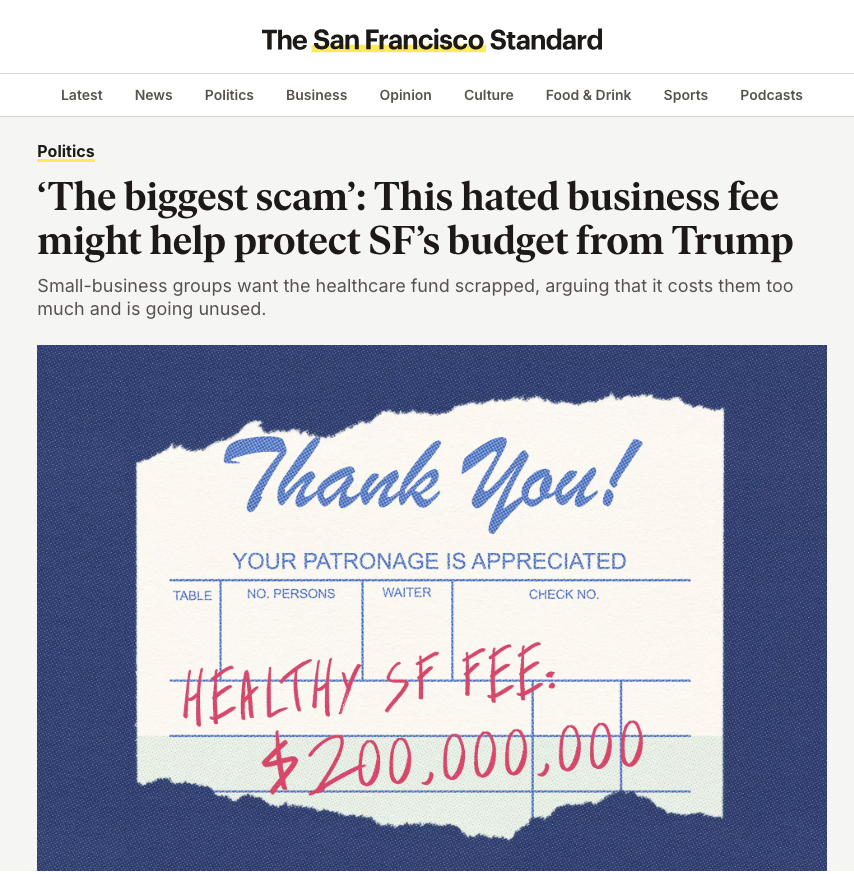
How it’s a tariff: Because these contributions can be expensive, many businesses pass the costs on to customers through fees on restaurant bills labeled “SF Mandate” or “Healthy SF.”
Some argue the HCSO may have outlived its original purpose. When it was passed in 2006, health coverage options were more limited. Today, with the Affordable Care Act and expanded healthcare choices, the landscape has changed.
In fact, the City Option Program accounts have millions in un-used money since many workers don’t use them (these un-used funds have been controversially used to plug City budget gaps). As Laurie Thomas, Executive Director of the Golden Gate Restaurant Association, put it: “Many additional healthcare options are now available. Given the amount of unused funds paid into the city’s account, we believe it is prudent to look to repeal this ordinance.”
Given this new reality, policymakers should consider whether the program should be updated or reformed.
.png)
Real Estate Transfer Tax
What it is: Formally called the Real Property Transfer Tax, but commonly called the Real Estate Transfer Tax, this is a tax on real estate transactions in San Francisco.
How it works: The tax is typically paid by the seller when a property changes hands. Unlike most California cities, San Francisco uses graduated rates, meaning the tax increases as the property value rises. Rates range from 0.5% to 6%, including 5.5% on properties valued between $10M–$24.99M and 6% on properties worth $25M or more.
How it’s a tariff: While many cities have transfer taxes, San Francisco’s rates are far higher. For comparison, transfer taxes top out at 1.1% in Chicago and 2.2% in Washington, D.C. As a result, SF property owners pay significantly higher transaction taxes than those in other cities.
High transfer rates also increase housing costs for residents. The Controller’s Office estimates that the transfer tax increase from 2020’s Prop I added about $64 per square foot to nonresidential development and over $32,800 per residential unit. The policy group SPUR has similarly noted that, “high transfer tax rates can discourage new housing construction and can worsen affordability in high-cost regions”
Thankfully, legislation has recently been introduced to reduce the real estate transfer tax, which we support.
The Headquarters Tax
What it is: The headquarters tax, more formally known as the Administrative Office Tax (AOT), is a tax on companies that operate in SF primarily as administrative offices i.e. headquarters.
How it works: Companies are classified as primarily operating as administrative offices in SF if they meet all of the following criteria:
- Over 50% of the business’s payroll expense in SF is related to providing administrative/management services for the business.
- The number of US-based employees is over 1,000.
- Has over $1 billion in gross receipts reported on U.S. federal income tax returns.
Companies that meet this criteria then have to pay the following rates applied to payroll expense based on tax year:
- For tax years 2025 and 2026: 1.47%
- For tax year 2027: 1.59%.
- For tax years beginning on or after January 1, 2028: 1.68%
How it’s a tariff: SF’s Administrative Office Tax is rare and not a tax that typically exists in other cities. Consequently, it imposes a unique cost on businesses that have their headquarters in San Francisco. Over the past years, major employers have moved their headquarters from SF, taking jobs and investment with them. Notable employers that have left include engineering firm Bechtel, financial services company Charles Schwab, and healthcare company McKesson.
.png)
