Fix San Francisco's Budget
San Francisco has one of the largest and most complex local budgets in the United States. With a roughly $16 billion annual budget, a ~34,000-person City workforce, and spending of roughly $19,000 per resident, the scale of government here rivals that of entire states and even entire countries. Yet despite this enormous level of spending and years of rapid budget growth, many of the City's most pressing problems such as homelessness remain unresolved. As San Francisco now faces a projected deficit of more than $1 billion by 2030, it is critical for residents to understand where the money is going, how the system works, and why the current trajectory is unsustainable.
The information below breaks down the facts behind San Francisco's budget: how it has grown, where the dollars are spent, and what must change to put the City on a more responsible fiscal path. If you're ready to take action now, press the button below:

San Francisco has a huge budget at ~$16 billion.
The budget is larger than:
U.S states such as Rhode Island, Vermont, Maine, South Dakota, Wyoming, Montana to just name a few.
Entire countries such as Bahrain, the Bahamas, Monaco, and Malta.
Despite this huge budget, our City is on the path towards bankruptcy.
.png)

Even compared to peer city-counties, San Francisco spends more.
When compared to peer city-counties using 2024 data, San Francisco has a larger budget on both a raw and per capita basis.
The following 8 city-counties have similar populations and Democratic Mayors (with exception of Honolulu, whose Mayor is an independent) to San Francisco:
- Denver
- Philadelphia
- Honolulu
- Jacksonville
- Indianapolis
- Kansas City
- Nashville
- New Orleans
And SF’s budget has only gone up since 2024.
Despite high spending, SF residents aren’t getting their money’s worth.
Today, the SF government spends roughly $19,000 per resident. Yet based on a host of metrics, this money hasn’t translated into top-tier services for residents:
- Over the course of a year, the City gets roughly 800,000 complaints - that’s almost 1 complaint per every resident who lives here.
- It takes 2 days or more for the City to clean up dumping or graffiti.
- Across the City, there are 6-9 car break-ins daily.
Shouldn’t we be getting more bang for our buck?

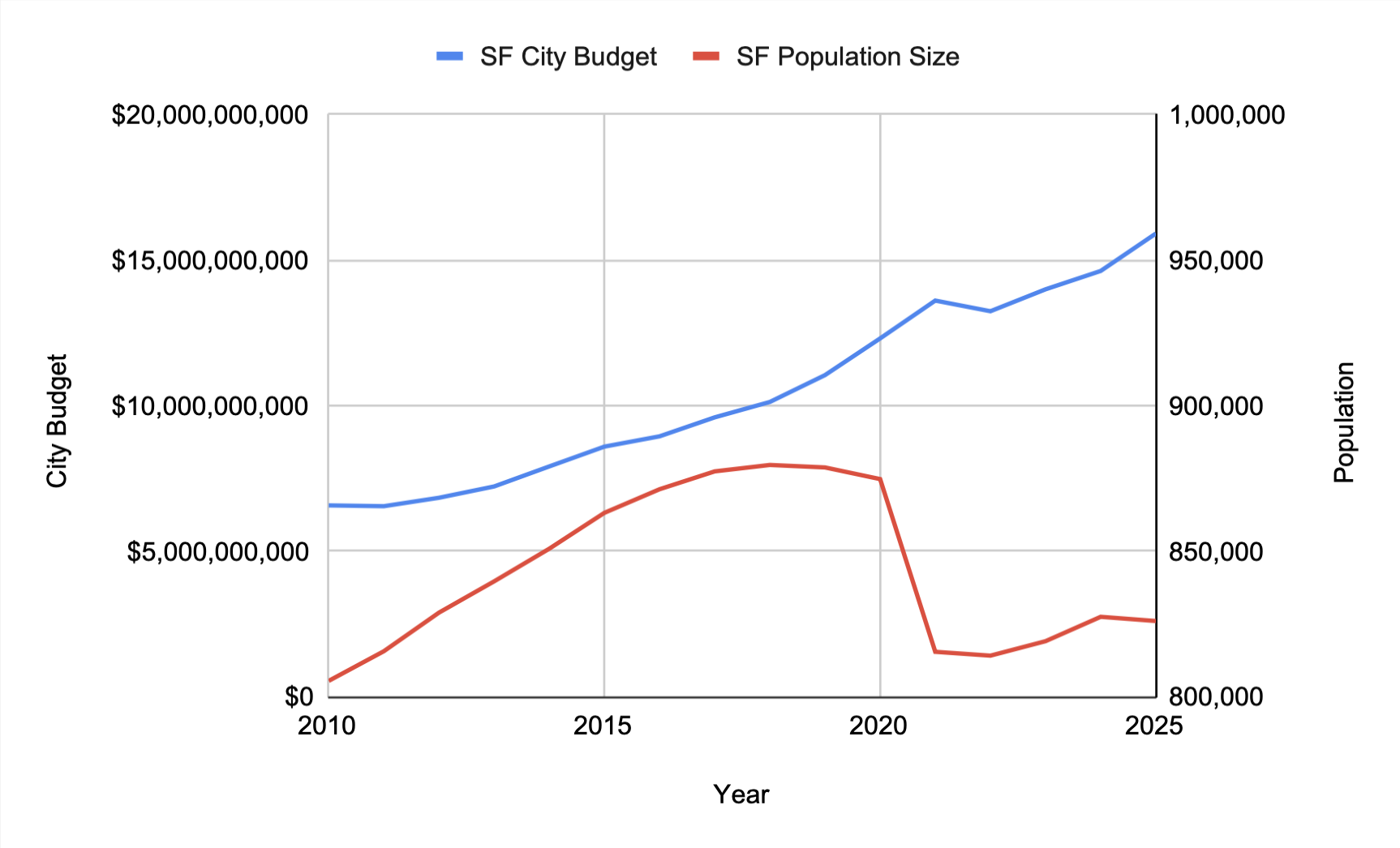
SF’s Budget has increased even as population has declined.
Even more bizarrely, our City's budget has grown since 2020 even as our population has declined from ~870K residents to ~830K residents.
You’d think with more money and fewer residents, services would be better.
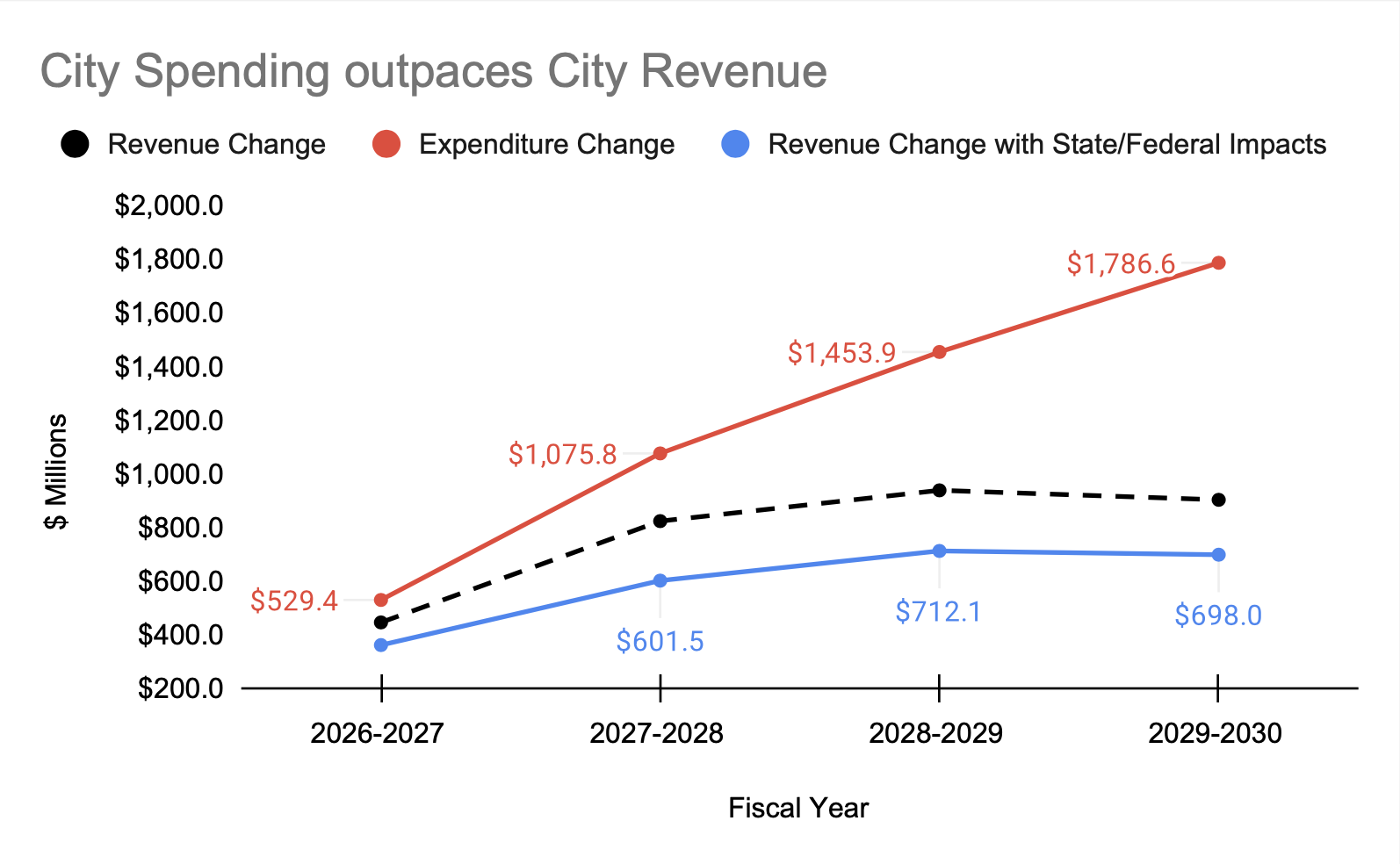
SF faces an over $1 Billion deficit by 2030.
The reality though is that City Hall’s high spending is not sustainable.
Thanks to over-spending, by 2030, SF is projected to have an over $1 billion deficit.
City Hall needs to reform our budget now to avoid a bigger disaster later down the line.
.png)
Unfortunately, City Hall has been avoiding the problem.
Historically and even today, City Hall has avoided tackling the fundamental spending problem causing the deficit by using the following tactics:
- Tapping into reserve funds meant for safe-guarding against recessions. Former Mayor London Breed used Covid relief funds, reserves, and prior-year savings i.e. fund balance to paper over the City's structural deficit. Keep in mind City deficit projections don’t factor in a recession; so we shouldn’t be using reserves now and be caught off-guard by an actual recession.
- Raising taxes. Raising taxes does nothing to address the City’s spending problem. In fact, raising taxes could backfire by driving businesses and jobs away, jeopardizing the City’s fragile economic recovery and shrinking our tax base. Unfortunately, there is a proposed tax hike, Prop D, on the ballot for this June, with supporters claiming it’ll help fix our deficit. Learn more about it here.
- Using short-term fixes and accounting gimmicks. Using short-term fixes and accounting gimmicks don’t solve the structural drivers of the budget crisis. Unfortunately, last year Mayor Lurie’s administration tapped funds from San Francisco’s City Option program, which the City has required small businesses to pay into to help fund their employees healthcare coverage. Instead of returning millions in un-used funds to those businesses, Lurie’s administration redirected over $200 million into a new Federal and State Revenue Risk Reserve to plug a budget gap caused by reduced federal/state spending.
What’s causing SF’s spending problem?
You’re probably wondering now what’s causing SF’s spending problem. As we mentioned before, SF spends way more compared to peer city-counties, some U.S. states and even entire countries.
But that doesn’t mean SF should just hack away at its budget indiscriminately. Analyzing public data, there are two areas of high spending City Hall should scrutinize more:
- The City’s unusually large work force.
- Homelessness and non-profit spending.
.png)
.png)
San Francisco also has an unusually large City workforce.
SF has a work force of roughly 34,000. Now you may say “But SF is a combined city-county, so of course it’ll have more workers than other cities.”
However, an SF Chronicle analysis controlled for SF’s combined status to do an apple to apple analysis with other major cities. And guess what? Even after controlling for SF’s combined city-county status, SF still has more core government employees per 1,000 residents than other major cities:
- SF: 24.4 core employees per 1,000 residents.
- NYC: 20.2 core employees per 1,000 residents.
- LA: 14.9 core employees per 1,000 residents.
Also worth mentioning: despite SF’s population declining since 2020, SF’s City workforce has increased since then.
Cutting staff is never easy. But the City needs to make tough calls now before the budget problem gets worse.
SF spends millions on homelessness but isn’t getting results.
The City also spends a tremendous amount on homelessness.
Two major departments that deal with homelessness and its related issues such as drug addiction, the Department of Public Health (DPH) and the aptly named Department of Homelessness and Supportive Housing (HSH), have seen their budgets grow significantly over time:
- DPH: Grown nominally by over $1 billion since 2017 to roughly net total $3.3 billion today.
- HSH: Grown nominally by over $500 million since 2017 to roughly net total $760 million today.
Despite increased spending, homelessness remains a persistent problem in San Francisco. Clearly, increased spending alone doesn’t translate to better results.
.png)
SF’s non-profit spending has exploded, but is full of scandals.
San Francisco spends a lot on non-profit contracts as well. Since 2019, non-profit spending has roughly doubled to $1.6 billion in 2025. And DPH + HSH are responsible for the majority of that non-profit spending, accounting for over 53% of 2025 spending. In fact, most of HSH’s department budget is dedicated to non-profit spending - 58% as of 2025.
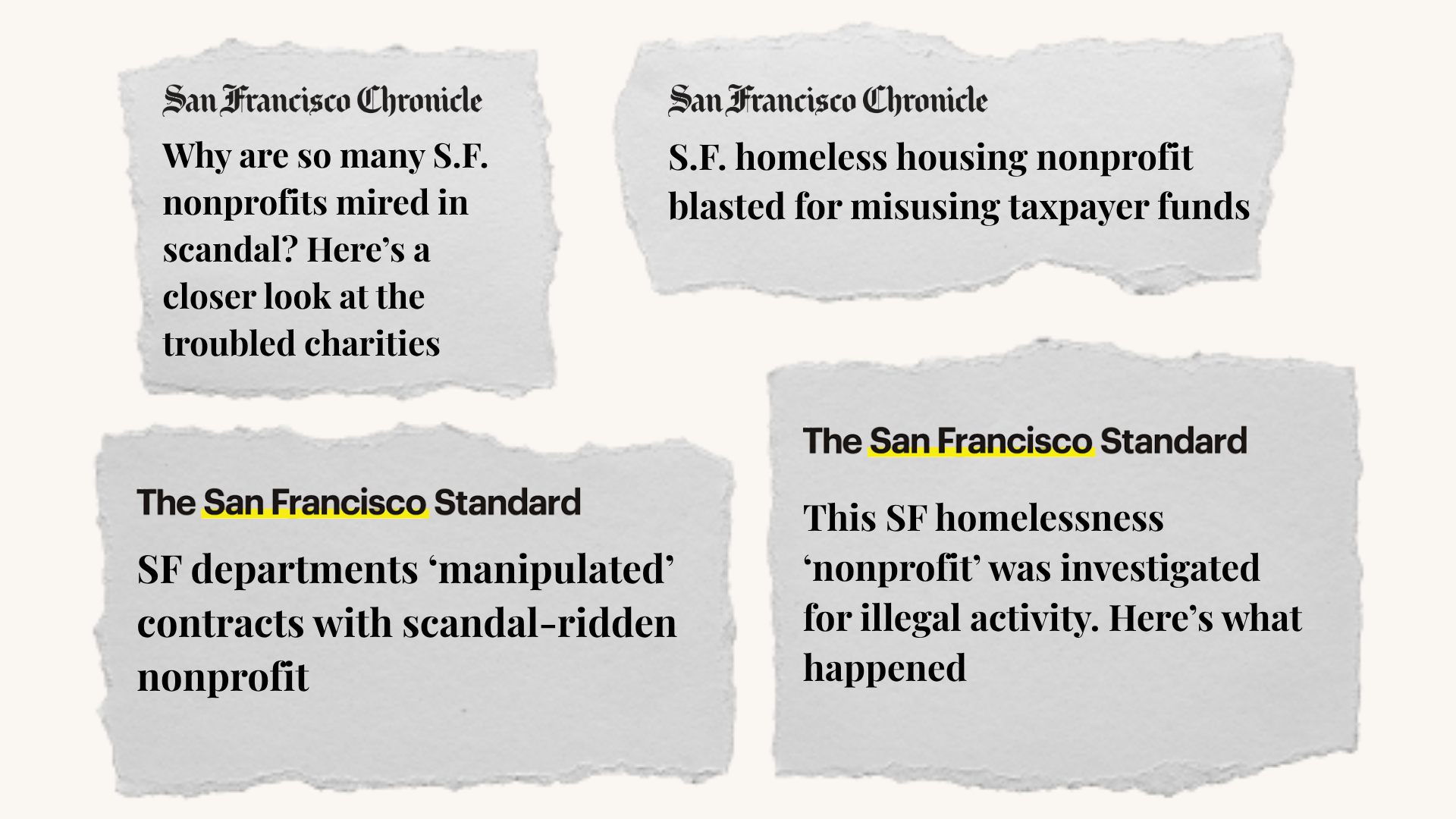
Unfortunately, oversight over contracts/agreements with non-profits has been weak, leading to multiple scandals and incidences of misused funds and outright fraud. Just a few examples:
- HomeRise: Homeless non-profit caught mis-using funds on employee bonuses and salary raises among other misdeeds.
- Urban Ed Academy: In-appropriately received millions from Human Rights Commission in a rigged contract selection process.
- United Council of Human Services: Homeless non-profit investigated by City and referred to FBI.
In the face of a budget crunch, it would be irresponsible for the City to not take a closer look at non-profit spending.
What you can do.
So here’s what you can do. As we laid out, if the City doesn’t take action now, we will face an over $1 billion deficit by 2030. And the math is simple - our budget crisis is a result of over-spending.
The City can’t keep dipping into reserves, using short-term accounting gimmicks, and raising taxes to fix a structural spending problem. That’s why for this budget cycle, we are demanding Mayor Daniel Lurie and the Board of Supervisors follow these three simple fiscally responsible principles:
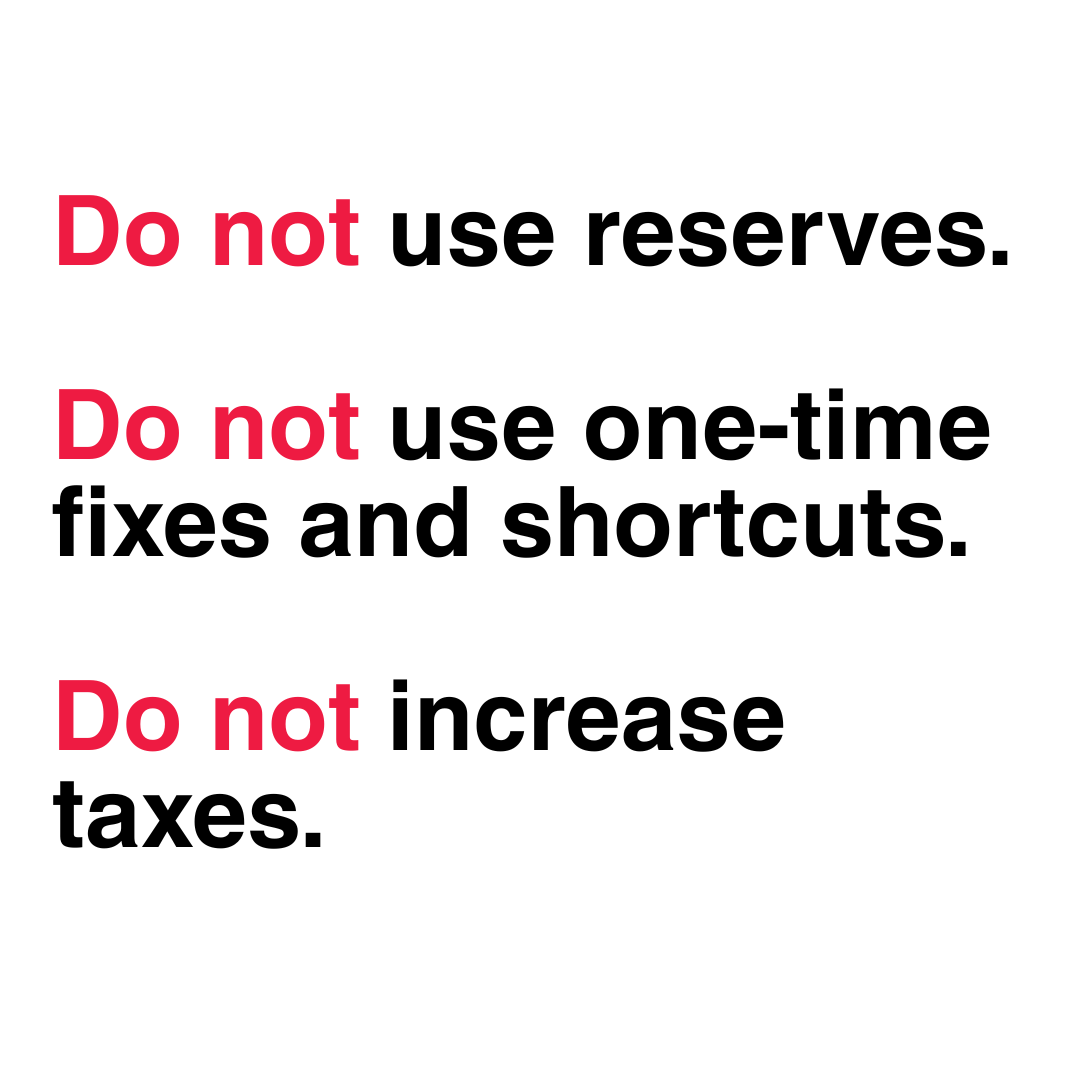
- Do not use reserves.
- Do not use one-time fixes and shortcuts.
- Do not increase taxes.
Using the form below, sign and send a letter to the Mayor and Board of Supervisors letting them know you support responsibly solving our City’s budget crisis.